Arabic Chatbot
Introduction
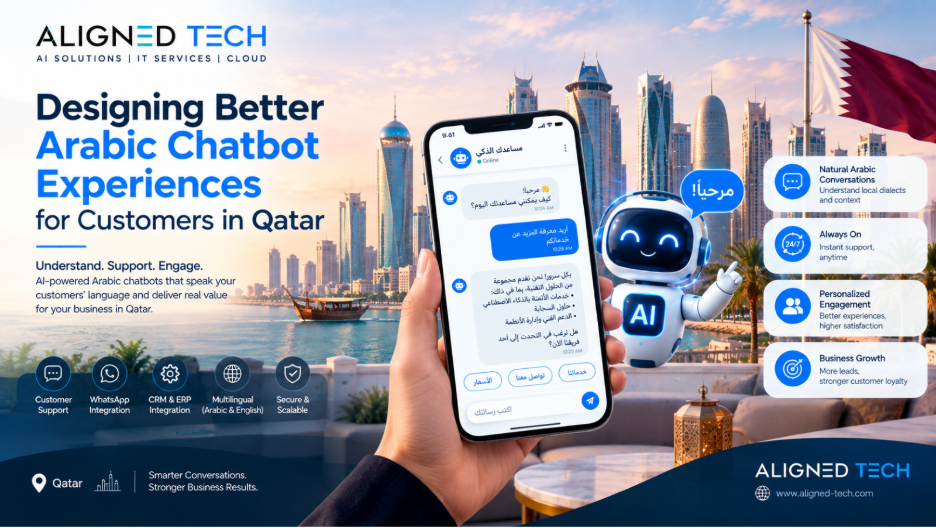
Chatbots have evolved from simple scripted tools into intelligent assistants capable of understanding natural language, retrieving information, and supporting business workflows. For companies serving customers in Qatar, language and cultural context are especially important. An Arabic chatbot should feel natural, useful, and respectful while helping the business achieve measurable objectives.
Why Arabic Matters
A customer may understand English but still prefer Arabic when asking about a service or communicating about an important request. Offering Arabic support can reduce friction and make digital services more accessible.
Effective Arabic conversational AI involves more than translating English responses. Arabic has regional variations, different levels of formality, and many ways to express the same intent. The chatbot therefore needs careful conversation design and a strong knowledge base.
Start With Customer Intents
Before building a chatbot, businesses should identify the questions and tasks customers actually bring to the organization. Common intents include asking about services, requesting quotations, checking availability, finding locations, arranging appointments, reporting problems, or speaking with an employee.
Mapping these intents creates the foundation of the conversation flow and helps decide which interactions should be automated and which should involve a human.
Design Conversations, Not Just Answers
A good chatbot does not simply produce individual answers. It guides the user toward a useful outcome. If a customer asks about a service, the assistant can provide an overview and then ask whether the customer wants pricing, eligibility information, or a consultation.
Clear choices, concise questions, and contextual follow-up make conversations easier to complete. The system should avoid unnecessary information and always provide a logical next step.
Arabic, English, and Human Handoff
Multilingual businesses should make switching languages easy. A customer should not have to restart a conversation simply because they changed from Arabic to English. The assistant can maintain relevant context while continuing in the preferred language.
Human handoff is essential. When a request is complex, sensitive, or outside the chatbot’s knowledge, the system should transfer the conversation with enough context for the employee to understand what has already happened.
WhatsApp and Business Integrations
For many organizations, conversational experiences need to extend beyond a website. WhatsApp can be an important channel for customer communication, and an AI assistant can help manage routine requests when properly integrated.
The chatbot can also connect to CRM, ERP, helpdesk, or other business systems. This allows a conversation to become an actionable workflow rather than ending with a generic response.
Security and Quality Controls
A production chatbot needs reliable information and appropriate access controls. Businesses should determine which sources the assistant can use and how frequently those sources are updated. Sensitive information should be protected, and the system should not expose data to unauthorized users.
Teams should test different Arabic expressions, spelling variations, mixed-language messages, unclear questions, and unexpected requests. Monitoring real conversations can reveal areas where the chatbot needs improvement.
Aligned Tech’s Approach
Aligned Tech develops AI assistants and automation solutions with a focus on real business workflows. For organizations looking for an Arabic chatbot in Qatar, a solution can be designed around customer service, lead generation, WhatsApp communication, internal assistance, or other specific use cases.
The emphasis should be on business value: understanding customer intent, delivering approved information, connecting conversations to systems, and creating a smooth path to human support.
Conclusion
An effective Arabic chatbot can become an important customer-service and automation channel for businesses in Qatar. The strongest implementations combine language capability with thoughtful conversation design, reliable business information, integrations, security, and human oversight.
About Author